
Comparing anti-VEGF dosing regimens in diabetic macular oedema
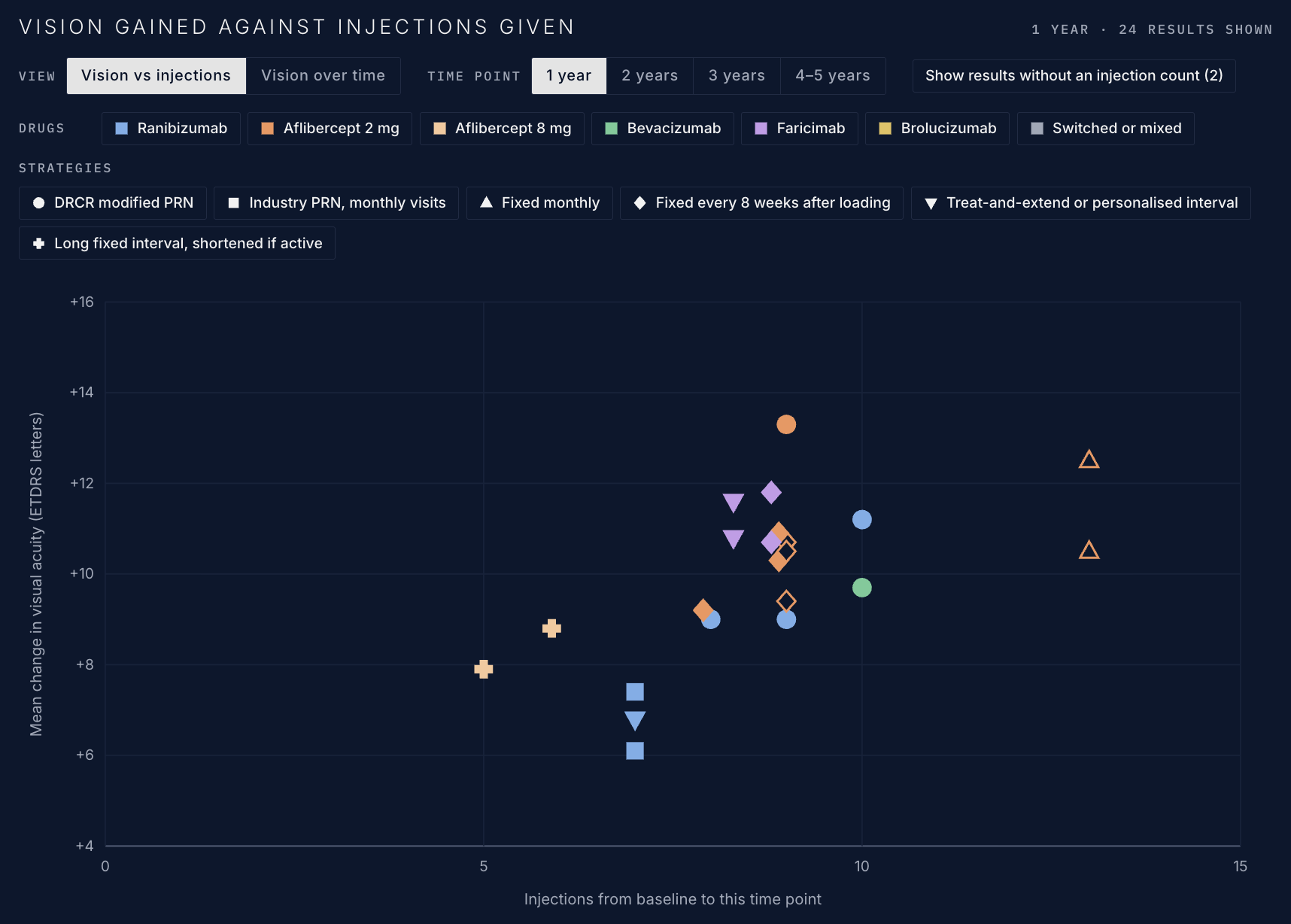
Diabetic macular oedema is treated with intravitreal anti-VEGF injections, i.e injection into the eye. A number of treatment regimes exist, and it is not clear if one is better than another. In published trials, patients are treated monthly, every 8 weeks, as required, or with a treat-and-extend strategy. Furthermore, DRCR.net (a large collaborative clinical research organization funded by the National Eye Institute uses an unique version of as required strategy for their trials.
To help clinicians and patients understand this landscape, I used a large-language model to search and plot the results of diabetic macular oedema trials to visualise the relationship between treatment strategies and visual outcomes.
View the DMO anti-VEGF regimen comparison full size
How to use it
This section is LLM written
- Choose a time point (1 year, 2 years, 3 years, or 4 to 5 years) to see the results at that stage of follow-up.
- Switch to the vision over time view to follow each arm across the years.
- Select a drug or a strategy button to show only those arms. Selecting more buttons adds them back.
- Select a mark, or a row of the table below the chart, to see the regimen, the trial population and the sources.
- A few results were published without an injection count. These are hidden from the chart by default and can be shown with a button.
The table below the chart lists every arm and time point, with the change in vision followed by the number of injections. Counts in italics are the number scheduled by the trial protocol rather than the number patients actually received. A separate panel shows the VIOLET study, which compared three ways of continuing aflibercept in patients who had already had at least a year of treatment.
Reading across trials
It is not possible to compare these trials directly against each other, because they involve different patient population, have different inclusion criteria, use different drugs, and the plots do not include confidence interval. However, by visualising the results of a trial with other trial outcomes, it provides necessary context to interpret the trial results and helps to draw conclusions.
If you have questions about your treatment after looking at the plot, please do not hesitate to reach out. I am happy to provide an assessment and to help guide your treatment.
About Dr Leo Sheck
Book your appointment now to see Dr Sheck
Dr Sheck is a RANZCO-qualified, internationally trained ophthalmologist and runs a popular and respected practice in Auckland. He combined his initial training in New Zealand with a two-year advanced fellowship in Moorfield Eye Hospital, London. He also holds a Doctorate in Ocular Genetics from the University of Auckland and a Master of Business Administration from the University of Cambridge. He specialises in medical retina diseases (injection therapy), cataract surgery, ocular genetics, uveitis and electrodiagnostics.
